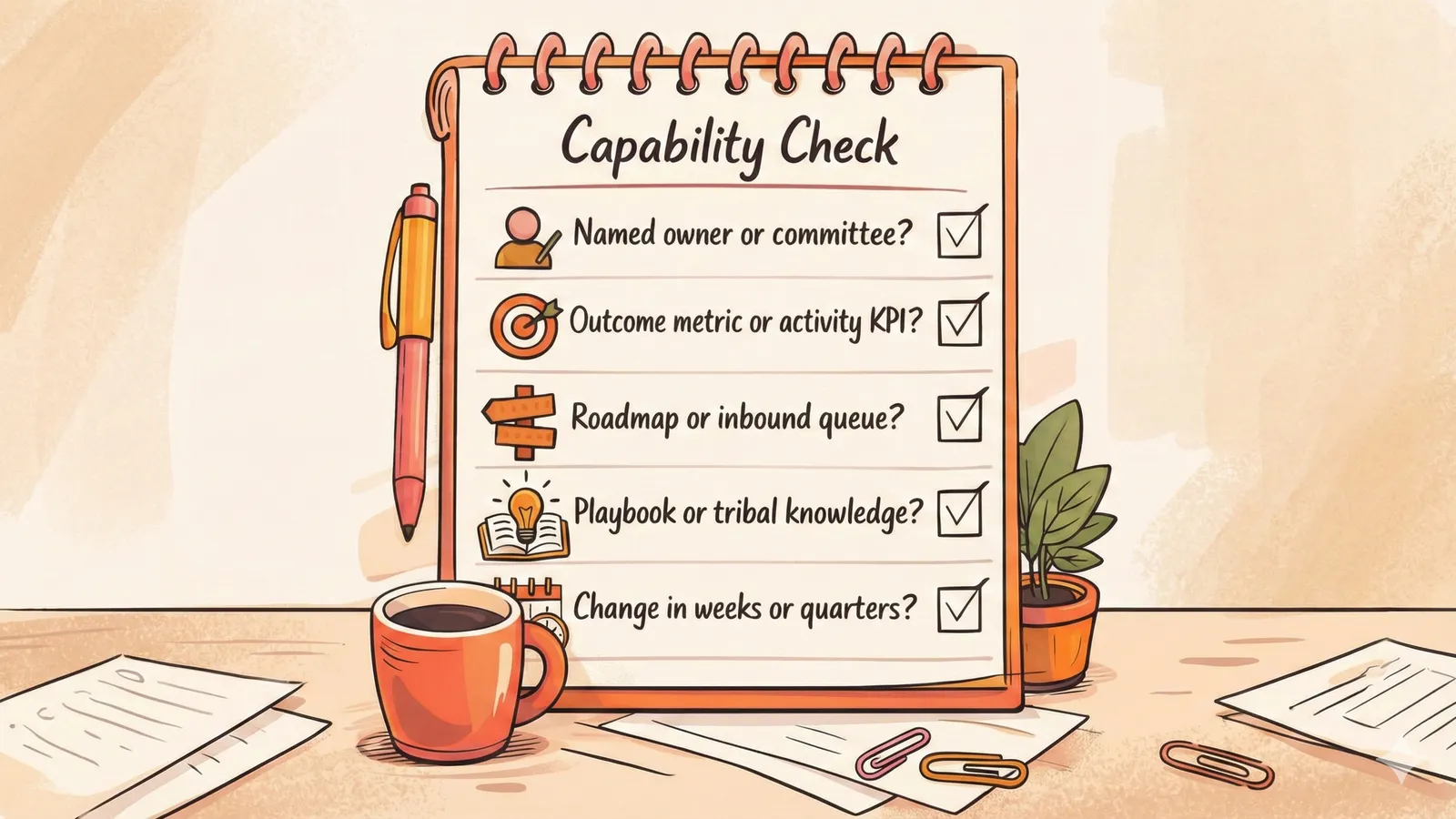
Most organisational “capabilities” look great when they are presented in a slide pack, then they fall apart the moment you ask who owns them or apply any kind of operational pressure.
There are some really common reasons this happens, and you don’t need to spend months doing an organisational review to figure out why that’s the case.
A quick framework for assessment
To run a quick check on your team, pick a capability your team should hold (eg “AI code review assistant”) and run it through the questions below. In most cases this is a 5 - 10 minute task with a cup of coffee and a notebook.
1. Is there a named owner, or a rotating committee?
Pass: There is one directly responsible individual with the remit and time to do the job and look after the capability.
Fail: “Working groups” that meet occasionally and no one can say yes or no.
Fail: A person who has the responsibility but not the time, skills or delegated authority to adequately look after it.
2. Are you measuring outcomes or activity?
Pass: An outcome metric tied to specific customer value or cost abatement.
Fail: Output measures like “20 tickets closed per week”.
Fail: Post-activity reporting such as “what we delivered last month”. (This is really common in monthly or quarterly Board reporting)
3. Do you have a roadmap or an inbound order queue?
Pass: A prioritised roadmap based on capacity, horizons, and explicit trade-offs being made based on a current understanding of strategic and operational context.
Fail: Slack or Teams pings, ad-hoc requests and issue queues driving the work.
Fail: Nothing ever gets deprioritised to make space for newer or allegedly higher priority work.
4. Is there a repeatable playbook, or tribal knowledge?
Pass: Fully documented playbooks, entry criteria, definitions of done. A new starter could execute the play on day one.
Fail: “Ask Sam” is the process (Only half joking here).
Fail: Faux-docs that either aren’t up to date, not comprehensive enough or are scattered across multiple locations (file store, confluence, ticketing, notion).
5. Is your change cadence measured in weeks, not quarters?
Pass: Meaningful improvements ship every 1-4 weeks - even if they are relatively small, but they drive meaningful, incremental progress.
Fail: Progress only appears in large, infrequent “big bang” drops.
Fail: Validation takes more time than the time required to create the change.
How aspirational is your capability?
If you hit three or more failures, the capability is aspirational.
To improve, start with the right foundations:
- Assign a clear Directly Responsible Individual (DRI) and delegate them authority to act.
- Define outcome metrics that align to customer value creation or cost abatement.
- write the playbook and test it out on someone new, or who doesn’t have complete visibility of how the capability should operate.
- Set a 90-day plan to get down to a two-week cadence for change delivery.
If you have 2 or fewer fails you’re in operational territory. Close the remaining gaps then you can invest further and scale confidently.
As the year winds down, pick a few areas in your team where traction feels low and run this check. It takes minutes and almost always exposes the missing foundations rather than missing effort.
If this feels uncomfortable, that’s probably the point.