Follow me. I know what I'm doing... (I think) - (CC) ajfisher
A large version is available at [wdcl2024.ajf.io](https://wdcl2024.ajf.io/) and a PDF of the slides, with notes [are available here for download (PDF 60MB)](https://wdcl2024.ajf.io/static/follow_me_talk.pdf). The full talk transcript follows: ## Where are we? We're all leaders here, and maybe a few soon to be leaders as well. So I want to get a quick sense of where everyone is on their leadership journey. A quick show of hands.  *All our journeys are different. (cc) ajfisher - Dall.E* Who has reports that are individual contibutors? Okay what about people who have 2 layers of reports? Anyone have bigger teams, maybe with 3 or more layers reporting into you? Okay, so we're mostly leaders who have ICs reporting into us. Now I want you to close your eyes... ### Imagine your team meeting Imagine, right now, you're standing in front of your team during a team meeting. But, I want you to imagine that team is two levels up from where you report right now. You're now also leading teams that aren't part of your direct experience. Maybe you're looking after design or marketing for example. 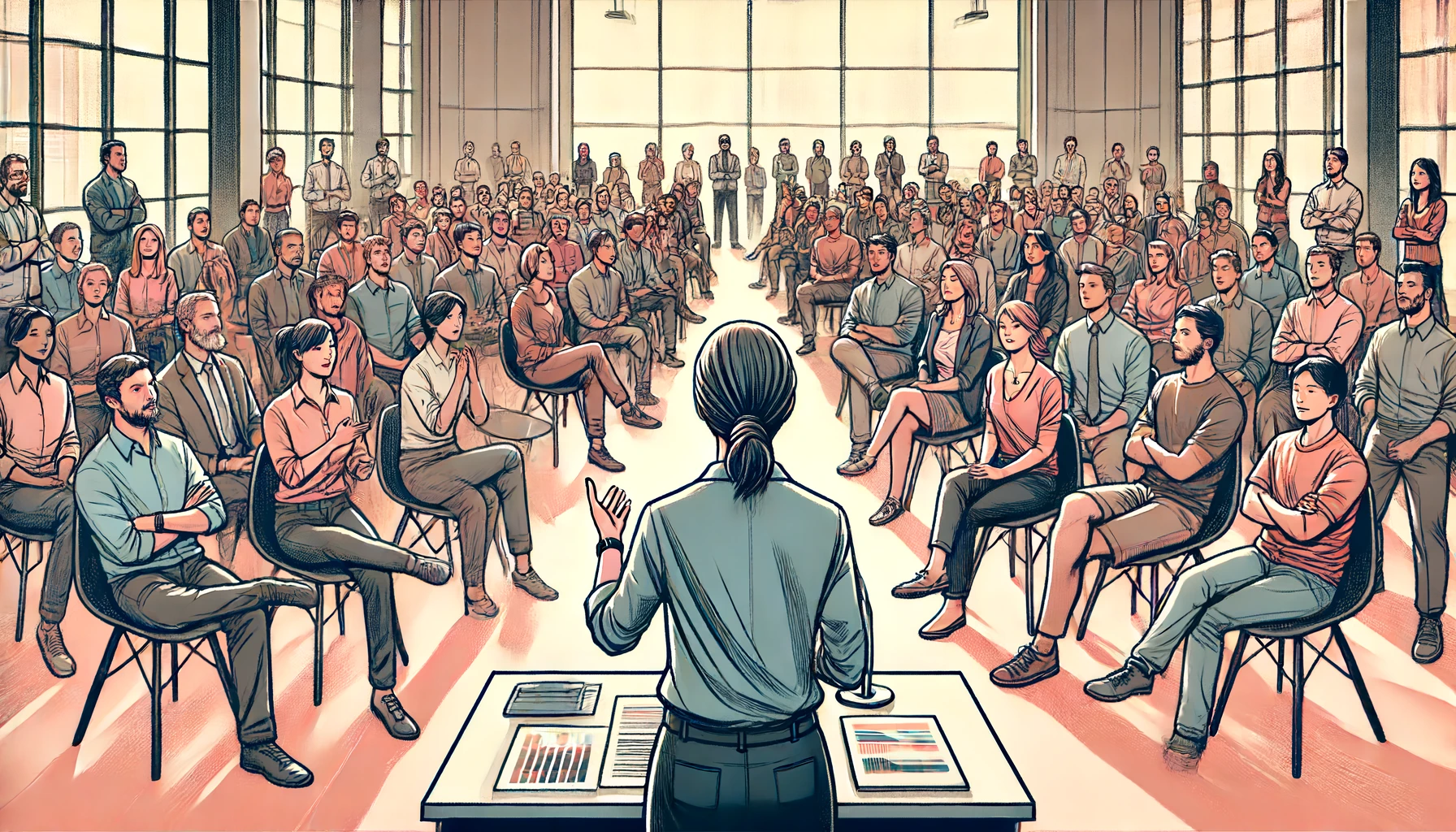 *Everyone is looking to you for direction. (cc) ajfisher - Dall.E* Everyone is looking at you. They are expecting you to give them the direction and priorities for the next quarter and your vision for where the team and the org is headed. Do you know what you'd say? There's probably a few of you in here thinking, "Yes! Finally I have the power to change all of the things that are wrong in this place!". Some of you might be thinking, "There's no way you can pay me enough to do that job." Wherever you fall, if you're serious about leadership as part of your career - and I think all of you are by being here today - there will come a point where your experience as a tech leader will be less valuable than your more general management skills. ### New types of challenges I got an opportunity to take that step several years ago and honestly, even with extensive leadership experience for more than a decade, I wasn't prepared. The gaps quickly became apparent and I realised this was going to be a steep learning curve. In retrospect, it was the most difficult role transition I've had since becoming a tech lead originally.  *The learning curve is steep. (cc) ajfisher - Dall.E* Today, I want to talk to you about some of the gaps you're likely to have coming out of practice leadership. But also give you some of the areas you can start to develop, regardless of what stage you are in your career. The great news is that management and leadership are skills, like any other - so you can develop them if you work on them. ### Agenda Today we're going to focus on these three areas: 1. Business strategy and drivers - Developing an understanding of the business strategy and organisational drivers. 2. Communications and relationships - Look at ways to communicate as a leader and how to build relationships to supercharge your impact. And; 3. People and team design - Give you some ways to think about your people, and team design. Let's dive in. ## Strategy and drivers We'll start by looking at the strategy and drivers and building that understanding as well as getting to know your customers. I'm not going to touch on the real mechanical stuff like building a business investment case or risk management etc. This is all pretty important, but there are heaps of good examples out there for this. I suspect some of you are probably feeding into or buiding these already. ### Understanding the strategy Let start at the top. When a business has a clear, well articulated strategy, everything just flows outwards from that. When everyone is aligned to it, the organisation becomes effortless.  *A clear blueprint allows everyone to work together. (cc) ajfisher - Dall.E* At its heart, strategy is as much about what you are NOT doing as much as what you are. ### Be clear about the goals However, if your strategy is not clear, or well understood, then everything that follows will be out of alignment and compound in terms of error.  *Miscommunication compounds in effects over scale. (cc) ajfisher - Dall.E* As a leader, one of your main jobs is to be very clear about the immediate and wider goals. You want to start getting comfortable with asking questions - especially about getting clear about what problem the team is solving for. ### Focus on the why For example - in your next planning meeting ask lots of questions that are less about the "what" and focus in on "why" this is important to your customers or strategy and "how" what you're planning is joining up to the organisational strategy. This will help you uncover the intent and anchor your approach to maximise impact. ## Organisational drivers Now, alongside our business strategy which sets out our goals, are the business drivers. Business drivers come down mostly to what are the main ways the org makes or spends money.  *Drivers allow the business to scale effectively. (cc) ajfisher - Dall.E* It really is as simple as this: > Money in - Money out = Profit Where the complexity comes in, is how you go about doing that in your particular organisation. But if you can understand how the core business functions, then you can start to understand where you can focus to drive impact. ## Drivers scale your impact For example, if I'm a retailer and 10% of my sales come from online and the rest from physical stores, there's a couple of ways to determine activities that would create biggest impact.  *Different channels have different impact. (cc) ajfisher - Dall.E* If I grow online whout sacraficing any physical store sales, I've just added to top line revenue- so I've improved my money in. If, I can optimise something in my physical stores that touches every sale, I can make 90% of my sales more efficient- so I've affected my money out. But, if I optimise something in my online channel, the mose I can impact is 10% of my total revenue. That might be more questionable in terms of importance.  *Optimise the right thing for maximum impact. (cc) ajfisher - Dall.E* When you understand how your business works, you can quickly determine whether a strategy you're considering is a good idea or not to pursue. ### Know your customers Alongside our strategy and our drivers, we then have our customers. Hands up. Who has had a direct interaction with one of your end customers during the month of June? Hands down if you're a consultant? As a leader, you need to know your customers first hand. You need to listen to them and walk in their shoes. ### Evaluate impact Building this understanding means you're able to bring first hand intelligence back to your team. It means you can validate approaches for things you are planning and see the impact of the initiatives you're doing.  *Learn everything you can about your customers. (cc) ajfisher - Dall.E* Go ask your customer or marketing teams for their customer reports and dig in. It's all too easy for us to sit in HQ and not iteract directly. But, if you talk to your customers, you start to appreciate the organisation's drivers in action and see how your strategy is working. ### Get started: So here are some thing you can do right now to practice this: Organise a 1 on 1, 2 levels up from where you report to find out more about the strategy Go talk to your finance team or channel leaders and really deep dive the drivers Next week, I want you all in the field having conversations with your direct customers. We've covered strategy and drivers, now we're going to turn our attention to communications and relationships to maximise our impact. ## Communications and relationships All of you will have seen how much impact both good and bad comms can have. Who here has ever said something to your team that was a bit loose and it's been totally misunderstood as to your intent? Yep - we've all done it at some point. When you get it right, good communications has a lasting impact across your team and org.  *Communications and relationships are a superpower. (cc) ajfisher - Dall.E* Alongside our comms, we also need to build relationships. Creating good relationships allows you to create impact across a much wider span in your organisation. Now, developing both of these skills requires no particular authority or seniority to work on them practically. We're going to touch on both communications and relationships. But lets talk about communications first. ### Communications Obviously, we want to be striving for clarity so we can get our message across. With a good team, your goal is to give them as much great information as possible so they can get on and do what's needed. There's a couple of techniques I find help with this. The first is focussed on asking lots of questions even if the question seems stupid or obvious. Often as a leader, you CAN be the person who asks the unaskable and you give permission to others to do the same. This allows us to uncover assumptions quickly. ### Gather perspectives The other technique is when you're working on solutions and providing perspectives in a group. You need to be mindful about your voice carrying more weight than others as you get more senior. You can't avoid this happening.  *Ask for the team's thoughts first so you don't bias their thinking. (cc) ajfisher - Dall.E* To balance this, make sure you are the last person to state your thoughts. You can be direct about that, "I want to hear all of you first", or just steer the conversation that way. This will give you more diverse perspectives which may inform your position further but additionally, it will also mean you don't tip the scales towards your opinion and have some of the group just agree with you. Remember, your job isn't necessarily to have the answer - it's to facilitate getting to that answer. Often, you're the one who takes accountability for the decision of the team too. ### Relationships Now let's turn our attention to relationships - a skill area I think is a super power in many organisations if you invest in it. Great leaders build a vast network of relationships across all levels and functions of the organisation. ### Build understanding To start, this gives you valuable intelligence: What are the pain points that team has? Maybe we can help. How is that project going? Their delay might impact our initiative. Mostly, this is about listening and asking questions of people in the org. But once you have a wide set of relationships you can also facilitate connections. ### Connect For example, if you're having a convesation with Alex and they have talked about a pain point they are experiencing but you know Jo had to deal with something similar, you can bring them together to collaborate on a shared objective. Now, how do we do this intentionally? ### Relationship mapping One way is to build a relationship map. If you're in a product squad you have probably seen one of these already. It's a stakeholder map but for you.  *Optionally do this with photos and pieces of red string (cc) ajfisher - Dall.E* You're trying to understand who you should be spending time with across your org to understand what is going on? Who do you need to spend time with to get things done or unblock things? And who do you know is going to need time so you can bring them on the journey for your projects as you're delivering. As you do this, don't forget externals. Make sure you include partners, key customes or other parties in this map as well. With your map in hand, it's then about spending time with these people to engage and listen. When you get a new role, this is really easy - you just reach out to all of your predecessors contacts and ask to chat to them about how your team is doing, what's good and bad etc. But even without doing that you can just reach out to people. People like it when you show a genuine interest to understand their area and how you might work better together. ### Get started: Your homework, is to start building out your relationshhip map and by the end of today, I want all of you to dash off a note to schedule time with someone in your org you don't know very well. So now we've talked about communications and building relationships, let's turn our attention to people and team design. ## People and team design When you lead bigger, and more multidisciplinary teams, success lies in the agency of others. As a leader you generally get the opportunity to determine your people and the ways your team work together. To that end, we're going to look at: * What capabilities do we need? * Direct team structure. * Ways of working. Let's start by thinking about the makeup of your team and specifically your immediate reports. ### Team skills It goes without saying that this team should be as diverse as you can make it to get the best mix of viewpoints and drive better outcomes. That's a whole other talk that others have done very well - you should conffab it.  *A balanced party gets the treasure (cc) ajfisher - Dall.E* For your team, the things you want to think about are what do YOU do in the team and what are *your* capabilities? And, what are each of your *reports* doing and what are *their* capabilities so you're all playing to your strengths? This sounds obvious right? But I see teams not be clear about this and so they aren't then clear about who is doing what. ### Building a capability model The way I think about this is by using a capability model. Start by breaking down all of the key capabilities the team needs to be good at to be successful against our mission. With this, you need to overlay the areas that you are good at and what you are bad at to help drive the structure. ### Team structure Start with the "what are you bad at" items and focus on that first. The way to address your gaps is by using the expertise of your directs to fill it. The person to fill this main gap should be someone that has extensive credibility in the capability and should also be senior enough to be obviously your second in command for the team. You need to delegate to this person, empower them and set them up to be the go to expert in their domain. This is a role that can help scale your team's communications and influence outcomes because now the two of you can be in different places at the same time with a cohesive message. ### Team structure Now I want you to think about which area are you most strong at. Whatever that is, you need a capable person to step in and you need to step away. Completely step away. How many times have you seen a leader spending too much time in the area they know really well and being disruptive, whilst the others go begging. Don't be a meddler in your team. AS you know this area well, you also know what great looks like. So you should be able to identity a fantastic candidate for this role, who can do it at least as well as you can. Then delegate it out and have a great person look after it. ### Team structure Now, the other roles in your portfolio are where you can mix it up a bit. This is where you can give people opportunities to step up, bring in a junior person or give someone the opportunity to X-skill. This is where the capability model helps because you can be clear about what the needs are and what is the best way to fill them. These roles are where you can spend a bit more time as a leader, growing the capability of the team, knowing the other areas will be dealt with so well. Here you can support on strategy or delivery as well as coaching and mentoring those team members. You should encourage your other heavy hitters to be doing peer based leadership and mentoring as well. ### Ways of working Once you have your team and how the structure will work, you should think about how you're all going to work together. This is primarily about how are we going to share information and who has authortity in different scenarios.  *Who holds the pen and why? (cc) ajfisher - Dall.E* Being clear about this stuff as a team means no one is dancing around afraid to step on each others toes. It also means the team are well informed and helps empower them to just get on and get things done - knowing they have backup. Your role as the leader in this is to facilitate the discussion and help surface assumptions about implied responsibilities or capability gaps so that all comes out on the table. ### Ways of working Many squads have a form of this using a team canvas or social contract. Use whatever works for you and your team or what you're familiar with. The key is to be having the discussion as a team and being clear about how you want to work together and who is doing what. ### Get started: So the obvious things to do here are to build out your capability model and have a session together working on this stuff as a team. Now we've our team is organised and we know how to work together, lets bring this all home and give you some resources. ## Things to consider  *Think about the things you can do to grow. (cc) ajfisher - Dall.E* As I wrap up, besides the homework I gave you, I want to leave you with a few things to have a think about too. ### Train yourself Are there courses that are appropriate for you to go on? Does my business offer leadership or management training? Can I get some training subsidised by work or other programs? ### Get yourself a mentor. Do you know someone in the organisation who you think is a great leader and you relate to their style or background? Are there people externally who might be a good fit for you? With mentoring, just reach out to people. Worst case someone says no, but is really flattered that you asked. Best case you get a mentor! ### Developing your skills No matter what level you're at, you can put many of the things I've talked about today into practice right now. Start trying things out with your team and start developing some of these skills and get the learning in before you need it. ### Summary We've covered a lot of ground today. * Understanding strategy and drivers. * Communications and relationship building. * People and team design. We talked about the importance of understanding the strategy and drivers of your organisation. We then went into being effective in our communications and how to build relationships intentionally. Finally, we touched on setting your people up the right way. ### It's your journey Being a leader is hard - but it is a privilege. When you create an impact, create great outcomes for your org and your customers it is incredibly rewarding - especially at scale. I'm probably biased, however given technology and digital permeate every part of the customer experience and enables all aspects of the organisation I think as technology leaders we have a great deal to offer organisations in senior leadership roles.  *We all have different paths to walk. (cc) ajfisher - Dall.E* And, we're starting to see those roles appear and begin to get those opportunities in non-tech businesses which is exciting. So it's time to get ready for them. Your career ceiling is no longer CTO or CIO it's wherever you want to take it in the org. I wasn't really prepared for my step up out of practice leadership and into a wider role and I had to learn fast. Fortunately, I was surrounded by a great number of people who were truly vested in my success and supported me. The earlier you start on this journey, the easier it will be to develop these skills and bring them to bear when you need them. ## Resources and acknowledgements [Additional resources](/leaders) can be found on a page dedicated to this topic with links to books, podcasts, videos and other material. This talk was developed on the traditional lands of the Bunurong people, Victoria. All images, unless otherwise attributed, produced using ChatGPT / Dall-E or Stable Diffusion models.