
I gave this talk at AI Engineer Melbourne 2026. The slides from the talk are embedded below, and the full transcript of the talk with key slides is presented after that.
Fail fast, fix faster: Why faster models can beat smarter ones - (CC) ajfisher
A large version is available at aieng26.ajf.io, and the supporting resources are collected at ajfisher.me/aieng26/.
The full talk transcript follows:
Fail fast, fix faster
Good afternoon.
I’m very pleased to be here this afternoon to talk to all of you about how, once a model is competent enough, the speed of your iteration loop matters more than the headline intelligence of the model.
Does smart mean slow?
 Does smart mean slow? (cc) ajfisher - ChatGPT Images 2.0
For a while now I’ve had this idea that instead of focussing on how well a model performs a task, what happens when a model gets good enough you expect it to succeed, and instead, benefit lies in how quickly can it achieve a result.
Earlier this year we got new models that made this idea worth testing and today I’ll talk you through the results of that and discuss the implications.
Tradeoff changes
 Good enough, but fast. (cc) ajfisher - ChatGPT Images 2.0
When Mercury 2 from Inception Labs launched it immediately caught my attention. It stood out because it was fast and seemed competent. It was not frontier level competent, but it was comparable to early-2025 models, and it could produce useful code in seconds.
After trying it, I was stunned, it was really fast.
This new model seemed to be a step change in terms of the way we think about the capability vs speed tradeoff.
The fast-loop hypothesis
 Fast-loop theory. (cc) ajfisher - ChatGPT Images 2.0
Off the back of this I did some quick calculations: if you could produce a loop that was really fast, could you brute force your way to success? Put another way, could you speed run a Ralph Wiggum Loop?
The idea was, if you have a lower capability model but a reasonable rate of improvement and you can iterate quickly, in theory you can outperform a slow, high performance frontier model before it’s finished generation.
A Ralph Loop is perfectly designed for goal based systems - assuming it has good feedback mechanisms
Looking at the Mercury 2 performance data I worked out that it should make this theory testable.
A couple of weeks later, Andrej Karpathy releases AutoResearch with a similar pattern but from a different direction. Cheap experiments, measureable feedback and repeated iterative improvement.
So with all of these ideas in hand I built a small benchmark to test the theory.
I’ll talk you through that now.
A benchmark for measurable work
Spec and rules
- OpenAPI contract
- Over $1000 quote = approve
- Line / Order Discount > 10% = approve
- Approval once only
- API best practices
Validation
- 47 parallel tests ~300ms exec
- Specific failure feedback
- Logic tests (rules, edge cases)
- API shape tests (headers, enums)
- Robustness tests (responses)
The task isn’t exhaustive in terms of model capability but it’s a job that should be familiar to all of you as you’ve all probably built something like this at some point.
The task is a Quote Approval API. It has an OpenAPI contract, business rules around discounts and approval thresholds, and 47 parallel tests that run in a few hundred milliseconds.
The agent harness
- Invoke models via API
- OpenAI, Gemini, Mercury, Ollama, alt local model providers
- Run implementation - validate - inform next turn
I then set about building a little agent harness modelled on a Ralph Wiggum style loop.
The agent harness does model API calls, gets the resulting implemenation and then runs it through the validation harness to test it. As much as possible, the models are coerced to use instant modes so they run at the highest speeds possible.
Once complete, the agents get the feedback of the turn, it’s current implementation and they are rebriefed on the goal and then they take another turn.
The run
- Run allowed up to 15 turns
- Each turn attains PASS / PARTIAL / FAIL / THRASH
- Record detailed trace performance data per run
- 10 fresh runs and aggregate model results
All together this creates the benchmark.
I limit the harness to run for a maximum of up to 15 turns. If it passes before that, then it stops and, likewise, there’s some checks to stop it if it gets stagnant and thrashes for several turns.
It does 10 fresh runs for each model so it can get a spread of results and then calculates its benchmark score from there.
Note: At this point in the talk I ran some live trace results side by side. This data is available in the GitHub Repo. Mercury 2 finished in 7s and GPT-5.5 took about 90s, with Gemini 2.5 taking about 70s and GPT-5.4 mini talking approx 45s.
Latency changes model economics
So why is diffusion so fast here?
It doesn’t inherently make the model smarter but it does change the cost it takes to produce the next candidate solution.
If you look at these two animations side by side you can see how different model architectures solve the same problem with two different approaches.
An autoregressive model iterates sequentially through tokens until it gets to a stop point.
A diffusion model starts from random noise and iteratively refines the output over a small number of steps.
For this talk, don’t worry too much about the internal mechanics of text diffusion - that could be a long talk on it’s own. The key is that candidate generations can be produced with extremely low latency.
Then, external validation can make these fast generations steerable using our Ralph loop set up.
What this means is that a marginally competent model coupled to a very high speed loop improves quality very quickly.
And I’ll show you why this happens.
Convergence compounds
score = 1 - (1 - r)^n
- r improvement against remaining error
- n completed iterations
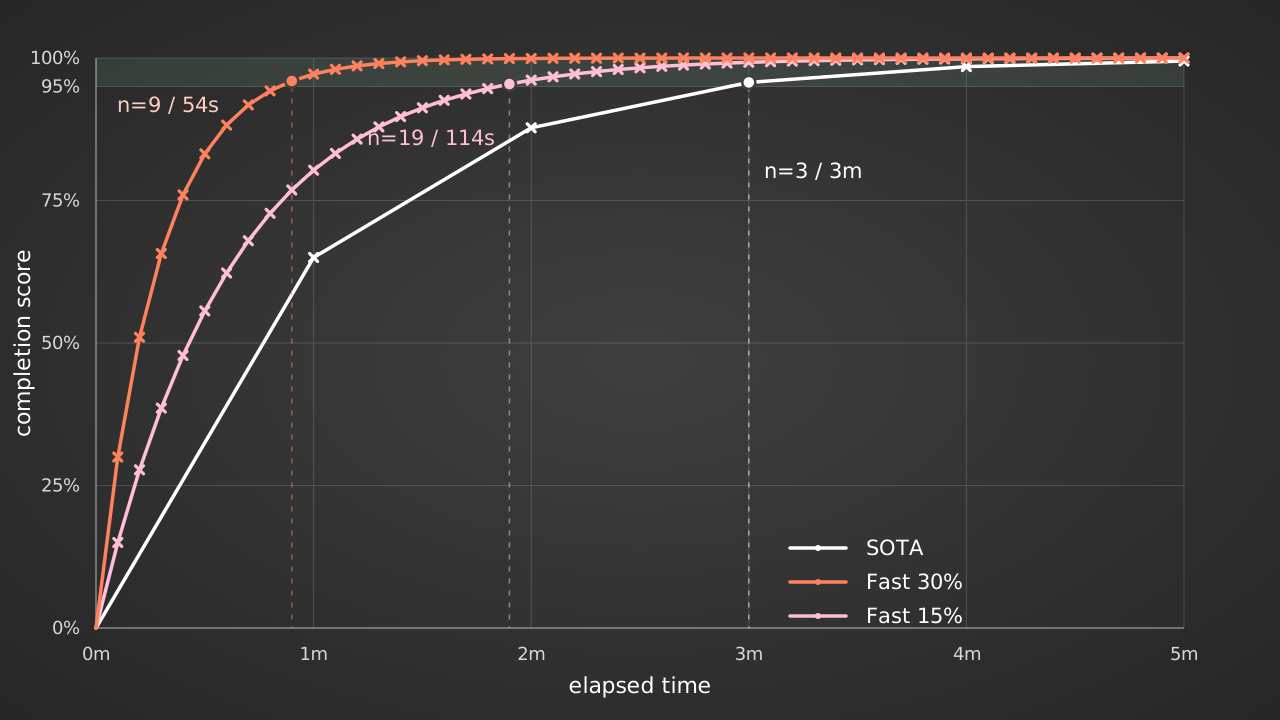
Fast iteration is important because progress compounds.
You can see how this unfolds in this equation, if each iteration removes some fraction of the remaining error - then the number of iterations you take starts to matter a lot.
A frontier model might make one big move and solve the task in a single step. But it takes time for this to happen.
A less capable model may need to make smaller steps, but if it gets way more attempts in the same window of time then those smaller moves compound on each other.
Small gains add up
 Small gains accumulate. (cc) ajfisher
So if we have a slightly less competent but extremely fast model, all it needs is a 20 or 30% incremental improvement against the remaining error every single step and it can get to the end point before the big model completes it’s one big step.
You can see this on this chart.
This process is like a compounding performance ratchet.
If you can move through each incremental step rapidly then you iterate your way to success very quickly.
But we need cheap experiments and measurable evaluation to push the ratchet.
And to do this we need good tests and feedback to drive it.
The headline result
GPT-5.4: one-shots more often, ~88s mean
Mercury 2: requires feedback to pass, ~6s mean
So let’s get back to our results, a taste of which you saw in the trace runs.
This is the headline match up.
GPT-5.4 solved this task the way we now expect. Pretty much one shot each go. But it took time do it.
Mercury 2 couldn’t one shot. It had to use the feedback loop. But the loop was so fast that the wall-clock time was tiny.
Loop speed changes system behavior
| Model | Class | Runs Passed | One-shot | Median Iterations | Mean Time To Pass | P90 | Best Failed Score |
|---|---|---|---|---|---|---|---|
| Mercury 2 | H/D | 10/10 | 0 | 2 | 6s | 7s | n/a |
| GPT-5.4 mini | H/AR | 10/10 | 7 | 1 | 41s | 65s | n/a |
| GPT-5.4 | H/AR | 10/10 | 6 | 1 | 88s | 101s | n/a |
| GPT-4.1 mini | H/AR | 10/10 | 0 | 2 | 54s | 66s | n/a |
| Gemini 2.5 Flash | H/AR | 8/10 | 0 | 4 | 77s | 589s | 0.947 |
| Gemma 4 31B cloud | H/AR | 10/10 | 0 | 5 | 133s | 209s | n/a |
| Qwen3 Coder 480B cloud | H/AR | 7/10 | 0 | 5 | 611s | 1154s | 0.957 |
| Orthrus Qwen3 8B MLX | L/D | 0/5 | 0 | n/a | n/a | 159s | 0.938 |
| Phi3 | L/AR | 0/5 | 0 | n/a | n/a | 355s | 0.125 |
Class (H=Hosted, L=Local, AR=Autoregressive, D=Diffusion)
Going beyond the headline, this table shows a summary of the traces I recorded across a selection of models. Some of these were hosted and some local, some diffusion and most autoregressive.
Speed aside, what you can also observe is that there is a competence threshold the model has to exceed to even be able to do the task. The model has to be competent enough that it can eventually finish the task with feedback.
You can see that a couple of the models don’t ever achieve the solution in ten runs with 15 turns. Ultimately they are not competent enough to solve this scenario.
The two highlights for me are:
- Mercury completed 10 successful runs in roughly the time GPT-5.4 took to do one.
- But GPT-5.4 Mini got the same result in half the time as it’s bigger sibling because it’s a tuned model and is more efficient at inference.
As I said a moment ago, loop speed changes the performance economics and these results change where the engineering work sits. Model intelligence does still matter, but the speed and quality of the loop starts to matter just as much.
So what’s the implication of this from an engineering standpoint?
Validation becomes the product
 Validation is the product. (cc) ajfisher - ChatGPT Images 2.0
It means that validation becomes the product.
The combination of specs plus your validation processes really becomes the core of what your product is, not necessarily the code you’ve produced.
If generation is fast, accurate and cheap then building the right thing is driven wholly by how you define what to build and then how to prove it’s correctness.
This means deep domain understanding and dense validation of that domain becomes your moat. Not how quickly can you build features.
How to build good validation
- Dense feedback
- Cheap error detection
- Fast feedback process
How do I build good validation?
- We need dense feedback so the system doesn’t thrash
- it has to be cheap so the system can detect an error easily
- And it’s got to be fast so that the feedback process can happen quickly
The quality of our validation really matters for autonomous systems.
This became very evident as I set up the benchmark. Bad errors cause stalls. Feedback gaps inhibit progression. Weak validations cause the models to thrash. You need to have a level of quality or the system can’t work autonomously.
As a pattern, this is more or less really test-driven development.
Test-driven development in this scenario is less about just building a confidence tool for developers. It’s now also a control system so agents can go away and build something, or rebuild it, or build five versions of it at the same time or optimise it.
It changes what we can use this for.
Sometimes you need more than speed
Fast iteration when:
- Dense feedback
- Measurable correctness
- Fast, cheap feedback
Frontier judgement when:
- Sparse feedback
- Subjective evaluation
- Ambiguous validation
Now, based on the results I showed you might be thinking you need to chuck out your claude or chatgpt subscriptions and go all in on diffusion models.
So I would be remiss if I didn’t call these things out.
Diffusion is not inherently better than an autoregressive model. In terms of absolute frontier, it’s not. We’re talking about a model that’s about equivalent to Gemini 2.5, but an extremely high speed Gemini 2.5.
The frontier still matters for a lot of tasks, and raw intelligence is important. You have to have to attain a certain level of competence before any model can be used for meaningful work and especially if you want to do it autonomously.
Autonomous systems work best when you’ve got dense feedback, measurable correctness, and cheap, fast validation.
It breaks down when you have sparse feedback, subjective evaluation, or slow or ambiguous validation criteria. In that scenario you still want to have one really good attempt, try to validate against that, and provide feedback to refine it.
The question shifts to feedback speed
- Explore alternative architectures
- Optimise system and validation speed
- Consider stronger harnesses
To wrap this up then.
The last few years we have been making models smarter and building harnesses to run them somewhat autonomously. Now, in order to use them more effectively we need to make our models and loops faster and more resilient.
The things I would encourage you to do off the back of this.
Try alternative architectures to see how they might fit different problems. Benchmark your total loop speed, not just output quality and look for optimisation opportunities. Invest in validation harnesses, because this is what allows autonomous models to progress.
Get in touch
Additional resources including slides
As I finish up I’ll leave you with this: Once a model clears the competence threshold, the question changes. Not just, “how smart is the model?” but, “How fast is the feedback loop?”