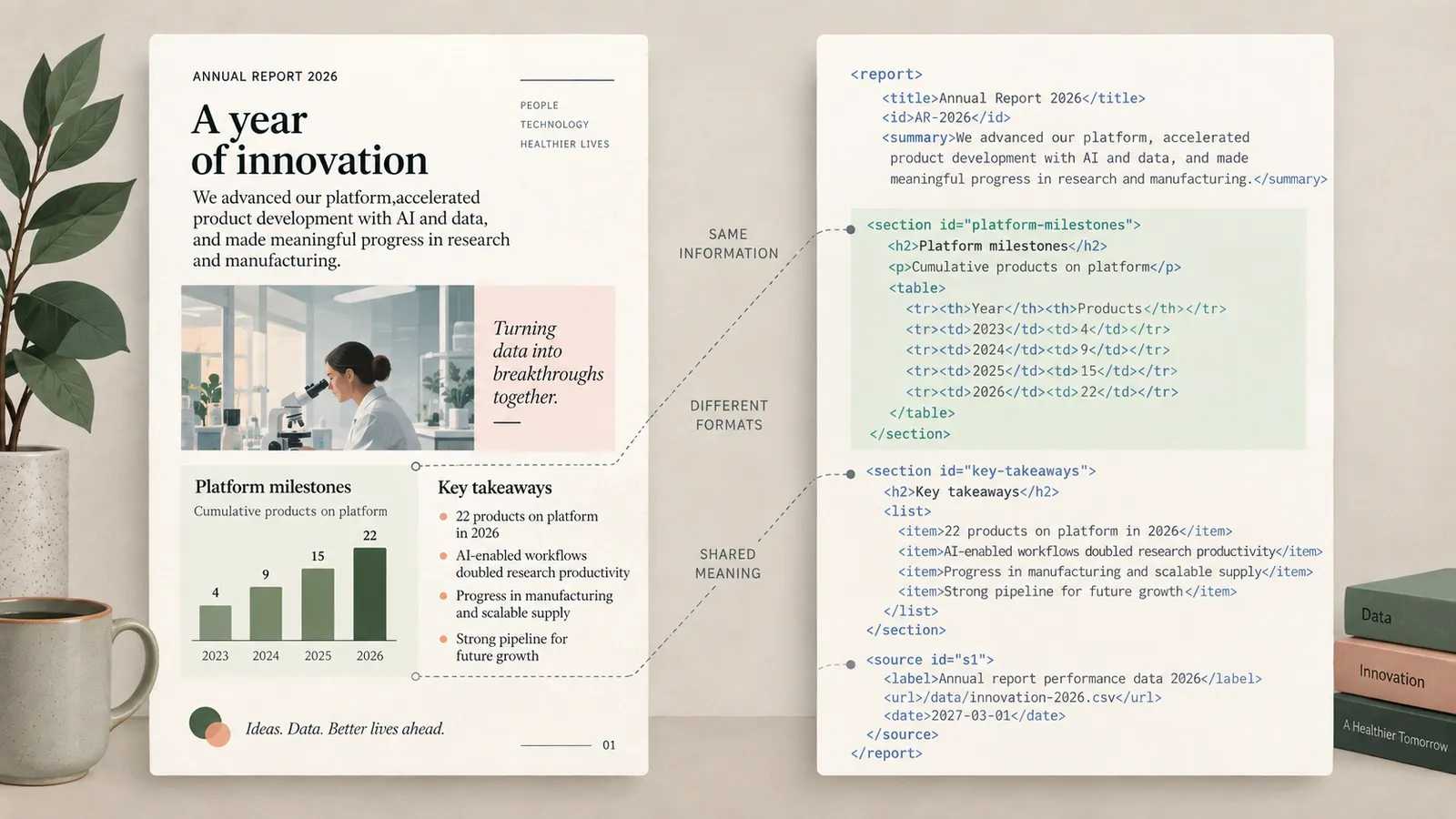
A few weeks ago I made a joke in a WIP meeting along the lines of, “given every professional uses AI now, we should make our annual report for AI tools as no human is going to read it”. It started as a joke, but we quickly decided that given how we blend AI and data to support our daily decision making, having our report natively accessible to machines would help analysts and shareholders better understand, integrate and interact with the information contained in it.
And so we decided to build a completely AI-friendly annual report and release it alongside all of our other, human-friendly material and do it in a way that would allow AI tools to work with the information in a structured, verifiable way. The feedback so far has been extremely positive, and based on feedback we are one of the first to actively do this.
The machine-friendly report is available at https://reports.tetratherix.com if you want to throw your own LLM of choice at it and ask it questions. Fair warning for humans: the regular version is 150+ pages long and the machine version strips out all the nice charts and photos and replaces it with structured text. Looking at the HTML version, you’d be forgiven for thinking you’d been transported back to a website from about 1999…
But that makes it very easy for a machine to consume.
I wrote a short post about why we did this strategically, and how it aligns to our general AI and digital strategy at Tetratherix. In this post I wanted to go deeper on the technical side and in particular how we created native verification in the system and output artefacts so a machine can easily validate and source claims for information.
The nature of an annual report
If you’ve never read an annual report: these documents are incredibly dense, the financials are subject to external audit and are an obligation for public companies to the market. Many companies also take the opportunity to dress up the finances with some thoughts on market conditions and updates on products and innovation. However, the performance information is the main game for analysts.
Humans skim through this pretty quickly then focus into more detail as needed, but an LLM will find this a mixed bag. If an LLM has to pass every page to its vision model to interpret it, this makes processing the information slower and less reliable.
Our goal was to simplify this all to text, in structured machine-readable formats that can be quickly absorbed.
As weird as it sounds, this became a Consumer Experience project with an LLM being the target Consumer.
Information architecture for machines
Many organisations think about the document output as the artefact being created but even a website or a PDF is just a presentation of information, not the information itself.
If you look at the report, you’ll mostly see what looks like simple HTML.
Behind that, everything is structured to provide clarity on how the information is organised and its relationships. This includes canonical representations of all sections, metrics, tables, footnotes and figures along with provenance information and stable IDs so it can all be cross-referenced.
The llms.txt highlights that the report.json file is the canonical structured machine version of the report and that semantic HTML, markdown and JSONL are all presentations derived from it.
## Files

- [report.json](report.json): the complete canonical model — every section, table, metric, note and reference, each with source-page provenance.
- [sections.jsonl](sections.jsonl): one JSON object per section, streamable (retrieval / RAG).
- [annual-report.md](annual-report.md): human-readable reading-order render.
- [annual-report.html](annual-report.html): accessible HTML edition (real tables, anchors).
- [source-index.md](source-index.md): every section / table id → source PDF page(s).
This allows the model to switch back and forth between presentations of the report depending on what the user requests with different formats supporting different types of analysis.
Going forward, we’ll be thinking about ways to manage for this and it reminds me of work I did for the NHS over 20 years ago where we built systems to deliver information so it could be printed and delivered digitally when both formats were in equal use by clinical staff.
Verification by design
A significant amount of my time over the last year has been spent researching how we design automated systems for trust 1.
In doing this work, and especially given the context of how it would be used, it was imperative that verification was built in from the start and flowed through every part of the pipeline.
Having methods of verifying that every claim, statement and number survives correctly through the transformation pipeline is critical. There is no hope or assumption in the system due to the volatility of the source 2. So you must be confident the system verifies in real time - as you can’t trust a human to manually check every iteration of a 150+ page technical document or trust an LLM to do it either.
How you do this largely depends on the source data.
We took a decision early to produce governed versions of every table and produce tables of the underlying data for every figure. These each became Excel documents that were version managed and were controlled sources. We then created reference links so we knew that when we had a table or figure in the report document, instead of trying to convert or interpret the “pretty” version, the system should replace the object with the validated version instead.
At the end of the pipeline we could then check this information back against the original source docs to prove correctness.
We also built verification checks to cross-validate all derivative values to prove that they were correct in the final output 3. This sounds like a simple check, but it caught a surprising number of transformation errors as well as upstream issues.
Adversarial verification by design
What I’ve found through other work is that most verification systems can be pretty simple. The key principle is that they need to be able to objectively evaluate the output and they need to be adjacent to your main pipeline or loop and feed back into it.
In a financial report, a cell being empty in a table has a different meaning than it containing a zero. Likewise, testing that a cell contains $4.2M doesn’t tell you if the sign flipped and you’re talking about profit or loss. Syntactically these are close, semantically they are very different.
Context is key and not every verification system needs this to the extent that I built, but some adversarial verification alongside your other techniques will prove useful.
This manifests in other ways too such as extracting a final table from its representation then verifying that the data in an HTML or markdown cell is correct with respect to the source data table. That way we know it’s transformed correctly 4.
Naïve tests will fail so adversarial thinking goes a long way with this type of content verification. Assume it can be broken. What are the ways this could break and now, how do we validate against that?
Consistency and correctness are different things
The section above deals with the correctness side of this verification but it’s not the whole verification story.
When you’re dealing with multiple forms of the same information, verifying that each form is consistent with the source data is a different and specific class of verification processes you need to handle.
At its simplest, it’s ensuring that each piece of information appears in every target representation. But it’s also verifying that all representations of that information agree with each other. In the pipeline these types of checks are explicitly called out and are marked to note that they are checking representational consistency, not correctness (which happens separately).
Another form of this is to ensure that information isn’t mistakenly injected into the representation because of a transformation quirk 5.
There’s no magical solution to build a test to answer, “is this correct?”. Rather, you compose a set of guarantees for a number of scenarios until you get to a point where the residual uncertainty becomes acceptable for the scenario you’re building for 6.
Conversion via LLM?
Transforming information from one form to another is a reasonable task for many top-tier LLMs now. So why didn’t we just give it to Claude or ChatGPT and say, “convert this PDF into a text document”.
This certainly would have been cheap to build, and we could have made it more dependable by using the API and feeding in a page at a time to keep the context small and then collate the results.
However, in a regulated financial document, this introduces a probabilistic interpretation layer which would need to be assessed by a human to verify it. It also introduces pipeline noise as there’s no ability to explain getting from a PDF page to a markdown file and no deterministic guarantee of repeatability (even when setting a low temperature).
Wherever a deterministic process was an option we chose it as it helps manage error risk and consequence.
Provenance as a primitive
A long time ago, one of my team threatened to throw something at me every time I mentioned provenance and how important it was for data-oriented automated decision systems. To be fair, most teams don’t really care strongly about the source of data and how it may have been treated 7.
That is until more recently, when the number and scale of automated decision systems and agents has increased dramatically.
As part of our system, we decided that provenance should be a first-class data type that becomes a fundamental primitive to help drive the system and guarantee claims.
Officially, the human-readable, market-submitted PDF is the definitive reference document. As we knew the machine version was going to break that document up and present it in different ways, it was important to ensure that every piece of information and claim was sourced back to the original 8, along with any structural modifications made (eg a chart replaced with a data table). This information had to be present in the canonical source but also flow through to the representations in a way that was native to that representation.
Working through the CX of building something useful for a machine consumer, this manifests as a source index which enables a mapping between representations and the source document.
<table id="tbl-consolidated-statement-of-cash-flows">
<caption>Consolidated Statement of Cash Flows <span class="src">Source: p. 93</span></caption>
<thead><tr>...</tr></thead>
<tbody>
...
<tr>
	<th scope="row">Receipts from Customers (inclusive of GST)</th>
	<td></td>
	<td>4,200,700</td>
	<td>-</td>
</tr>
<tr>
	<th scope="row">Payments to Suppliers (inclusive of GST)</th>
	<td></td>
	<td>(10,423,126)</td>
	<td>(3,589,318)</td>
</tr>
...
</tbody></table>
Similarly, because the system takes the source then builds the canonical reference, classic build tools can be used such as byte checksums to help show if source data changed and the pipeline is now using stale data. All of this is included, thus providing downstream trust markers for the consumer.
{
  "file_count": 28,
  "files": [
    {
      "bytes": 417002,
      "path": "annual-report.html",
      "sha256": "1335aa0e857353000483bb7be086e21415f0d020a3934e77ac635f4b96b2efb2"
    },
    ...
  ],
  "generator": "ttx-agent-report",
  "generator_version": "0.3.0",
  "mode": "final",
  "source": {
    "document_id": "ttx-ar-final-28ad070d047e",
    "page_count": 153,
    "sha256": "28ad070d047ed77ba70bc12e64db3219123bdcaff652dc278d037ee140657676",
    "status": "final"
  },
  "total_bytes": 3292079
}
Provenance is particularly beneficial for agentic workflows to help deliver trust downstream.
Say you task an agent to compare CAPEX spend across multiple financial years, classify the types of spend and show how that’s changing.
An agent can do this task and give you an answer that is objectively useful without provenance.
With native provenance information, the agent can give the answer alongside the provenance information which allows another system to independently establish why that answer can be trusted 9. This makes the answer considerably more valuable in higher-consequence downstream decisions (such as altering your share portfolio or your estimate of what a reasonable share price might be for the company).
Building something that is beneficial for an agent usually means it provides benefit to its human counterpart too.
Doesn’t RAG address some of this?
Retrieval-Augmented Generation (RAG) is tackling many of the same problems but from a different perspective.
Typically an AI consumer has to deal with a hostile (or difficult) document such as a PDF that is provided by the publisher. The system takes the document, parses it, chunks it, creates embeddings so it can be searched semantically, and then the consumable chunks are easier for an AI to consume.
The accuracy of this is contingent on how good your personal or organisational RAG system is and it has to account for a wide range of document types.
Our approach inverts who does the work and we know our content better than anyone. We also have all the source data so a random RAG system doesn’t need to try to derive it with mixed likelihood of success.
Economically this makes sense too. Why ask 10,000 agents to take a PDF and try and infer structure and parse the data when we can do it one time with the best knowledge of the information structure? Those 10,000 agents can just consume it and everyone saves resources.
The design of the system is already retrieval-oriented as you can see in sections.jsonl. Each section has a stable semantic identity, tables remain tables, as do figures, and relationships are structured and explicit.
{
  "id": "chunk-sec-people-and-culture",
  "section_path": [
    "TTX by the data",
    "People and Culture"
  ],
  "heading": "People and Culture",
  "text": "25 FT Employees # (Full-Time Equivalent)\n\n94% AI Daily usage in initial onboarded cohort\n\n0 Employee regrettable loss over 5 years",
  "table_ids": [
    "tbl-curated-p26-people-culture"
  ],
  "page_start": 26,
  "content_type": "management_commentary",
  "provenance": {
    "source_document": "ttx-ar-final-28ad070d047e",
    "source_sha256": "28ad070d047e…",
    "printed_page_start": "26",
    "extraction_method": "semantic_reconstruction"
  }
}
If an organisation wanted to ingest our information, it already has explicit structure and semantic boundaries so a RAG system can chunk it deliberately rather than try and infer structure from a flattened output document 10. All you need is to run it through your preferred embeddings model then store it.
Having built multiple RAG knowledge systems I’ve spent a lot of time cursing source documents, formats and spending way too much time on chunking strategy or reverse engineering some publisher’s structural decisions.
If all publishers built machine-ready representations of their information, the role of RAG can move away from processing and actually towards retrieval 11.
Machine-native is responsive design
For a very long time I’ve argued that the context of the consumer of your information or service is what matters.
With an internet and web dominated by human actors this means responding to whether they were using a phone or a laptop, on a high-speed connection or intermittent mobile network, or what time of the day it is.
As the internet and web become agent-dominated, this is another version of contextually responsive design. But, this time it’s about responding to an actor that prefers text, structured data and extensive metadata.
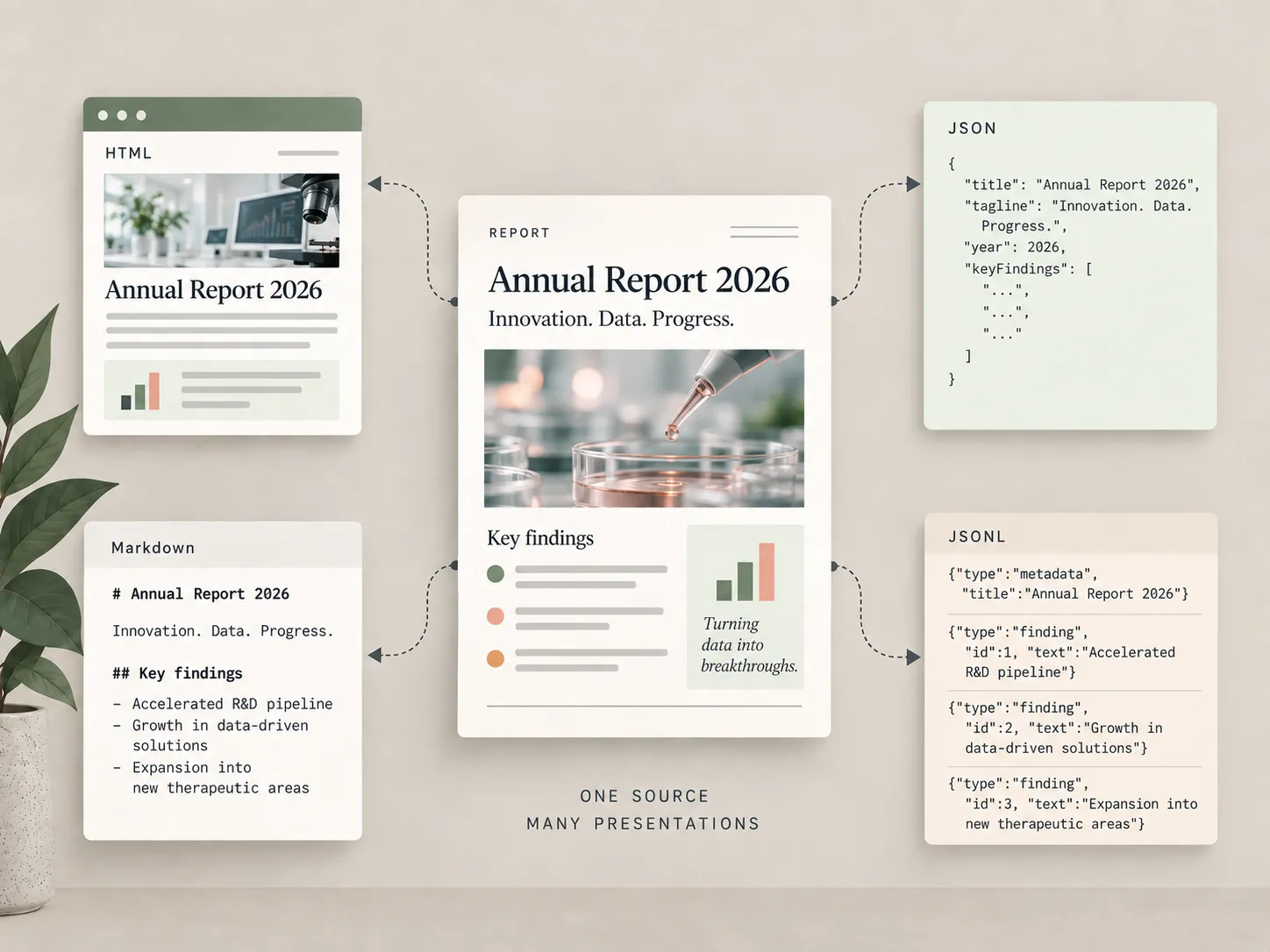 One source, correctly validated, can power multiple presentations for
different uses. Image: ajfisher / ChatGPT Images
One source, correctly validated, can power multiple presentations for
different uses. Image: ajfisher / ChatGPT Images
Some (like Katja Forbes) are already working in this space and thinking about how to design systems that support agentic commerce but we would be remiss if we assume these techniques only belong in retail transactions.
Presently, our systems of production prioritise a human-first approach, assuming they are the priority consumer 12.
The future is considerably more messy and in many cases we may be transitioning back and forth between a human and their agents working collectively. So the actor is not one or the other but rather both.
For twenty years, we’ve been focussed on devices for responsive design. Some orgs also focussed on context. Now we need to make our information responsive to actors too.
Our authoring and publishing systems will need to change too. Humans want narrative, design and progressive disclosure whilst agents want explicit structure, stable identities, provenance, data completeness and cheap verification.
Neither representation needs to be privileged and they can both be governed and compiled from the same source information. But we’ll need to develop systems and processes that can account for these needs.
For us, anything greenfield we’re already building thinking about agent consumption and we’ll look at ways to apply the approaches from our recent work to existing systems as well. The role of agents in our work is moving at pace and we won’t get the luxury of waiting while mobile devices slowly diffuse across populations; this change is here already and only deepening.
Whether you’re interested in Tetratherix or biotech I’d encourage you to point an agent at https://reports.tetratherix.com/llms.txt and see how your tools can interact with this type of information. If you do something interesting with it I’d love to see it.
Footnotes
-
To be fair this goes back a lot further such as to work I did at JBA / Kalido on machine learning systems for consumer segmentation and addressing bias in automated decision-making. ↩
-
In the period leading up to market release, the source documents are being edited by a large number of people including feedback from external auditors so the volume of changes is very high right to the last minutes before release. ↩
-
This extended to even something as simple as a sum of a column of numbers or any other multi-step calculation. Applied at the start and end meant that having this derivation check in place provided additional independent verification that the pipeline worked and that the source data tallied up correctly too. ↩
-
Conceptually this is like a unit test that isolates a single function to verify its behaviour but is applied to content translation between source and presentation instead. ↩
-
This is relatively common when you’re going from more complex document forms such as JSON or HTML to things like markdown. ↩
-
What your tolerance for uncertainty is will depend on the scenario. In our case of the annual report we had a low tolerance when it came to claims and financial numbers but if a heading was at the wrong level structurally then this would be okay. The key is to pick which hill you’re prepared to die on with regards to verifying correctness. ↩
-
Outside of a few people within organisations talking about data quality guarantees and data architecture. Many orgs dismiss this under claims of being too perfectionist or purist or potentially don’t even realise this may be an issue. ↩
-
Literally which page and section did this particular claim or figure come from. ↩
-
This could be an LLM or judge model, a deterministic evaluator or even a probabilistic evaluator such as Jev. ↩
-
Because this makes ingestion simpler you can have cleaner, more meaningful chunks. As such, you don’t need to guess with your chunking strategy or rely on shotgun-overlap to compensate for uncertainty. That work is already done. (You’re welcome) ↩
-
On the face of it, RAG as the name of the technique belies the sheer amount of effort most orgs spend getting information into some sort of form that the RAG element can actually do its job. ↩
-
Many organisations not only prioritise humans but, beyond some search engine optimisation (itself rapidly disappearing), they don’t consider non-human consumers at all. ↩